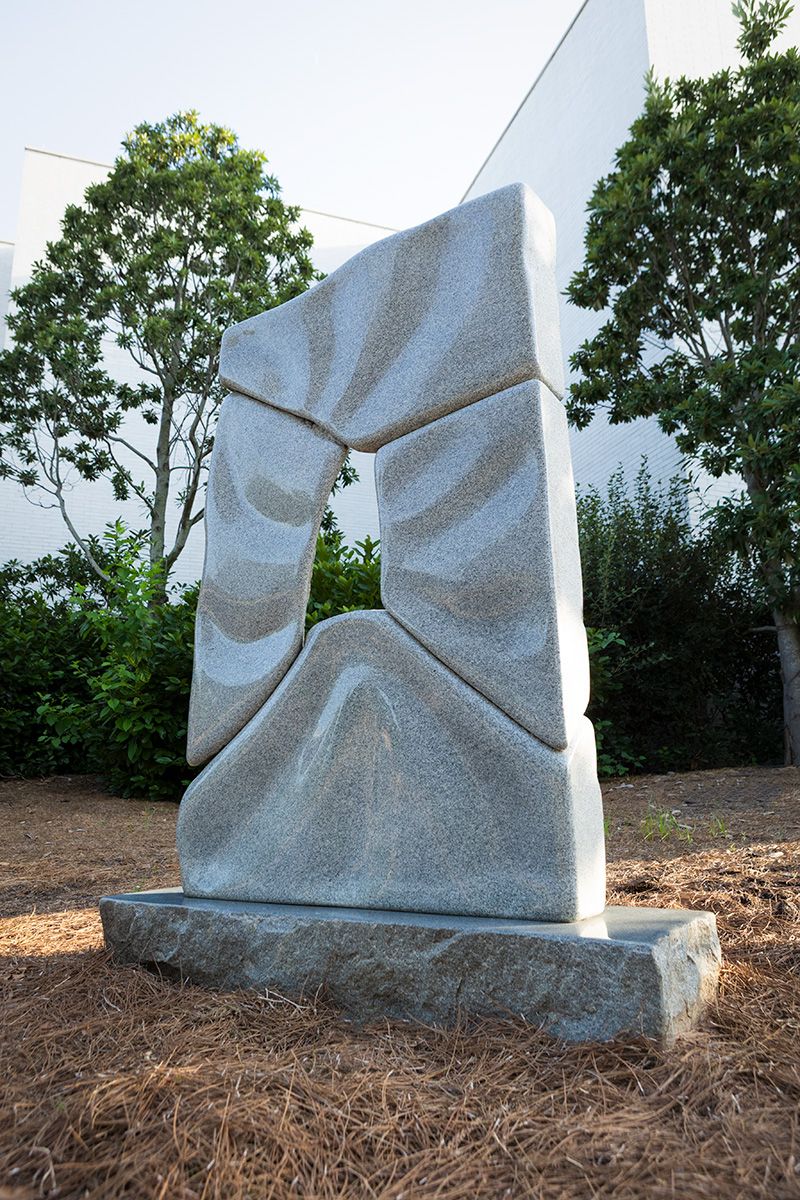
Formed over millions of years through heat, pressure, and time, granite is one of the hardest materials on earth. It resists cutting, dulls tools, and demands physical effort at every stage. Its density and durability are the result of geological forces that cannot be easily altered.
Jesús Moroles understood this not as a limitation, but as a starting point. For him, art was not about imposing form onto a passive material, but about sculpting granite to reveal its structure and character.
He believed that each stone already held its own history and form, and that the role of the artist was not to create
something new, but to expose what was already there. Cutting, splitting, drilling, and polishing the surface, he described his process as uncovering the truth of the granite. At the same time, he left visible evidence of that process, with fractures, drill marks, and chisel marks that record both the material and the work required to shape it.
This relationship to material and labor was shaped early in his life. Moroles grew up in Texas, working alongside his family in construction and masonry, digging ditches and moving earth by hand. He later worked in a monument shop, carving small-scale forms, before traveling to Italy to work in a granite quarry.
There, encountering stone at a vastly different scale, he began working with new tools and technologies that allowed him to cut, move, and shape massive blocks. These experiences deepened his understanding of both the material and the work required to alter it.
Moroles returned to the United States and established a studio in Texas with a commitment to working with granite at a monumental scale. Visiting quarries, he would select blocks of stone based on size, shape, texture, color, or even a vein within it. He could allow these massive blocks to sit for years until he saw something new in them that needed to be unearthed.
In the Broken Earth series, Moroles would often leave one half untouched, while sculpting and polishing the other, creating a direct relationship between the natural surface and the evidence of his labor. Though the works from the Broken Earth series take different forms, they each reinforce the balance between nature and human.
“My first stone carving was digging that ditch. My tools are the same tools that I started with. I am still trying to figure out what I can do with a chisel and hammer,” the artist shared. “As soon as you touch stone with a chisel ... you kill the quartz and it no longer reflects light. So I tear it, like tearing paper, to show the inside of the stone and all the facets that reflect light.”
For Moroles, it was not about competing with the forces that formed the granite, but responding to them—deciding what to cut and what to reveal.