The Industrial Revolution produced machines that transformed how people worked, built, and moved through the world. These systems relied on interdependent parts: gears that synchronize motion, chains that transfer force, springs that compress and release, and joints that connect parts.
When these systems work together, their movement feels rhythmic and precise. But if a single connection fails, the entire system can break down.
For Kenneth Baskin, that understanding comes from experience.
Before turning to art, he worked as a maintenance technician in a production facility outside Detroit, climbing inside machines, diagnosing problems, and rebuilding parts. In that environment, he learned not only what machines do, but how each component depends on the next.
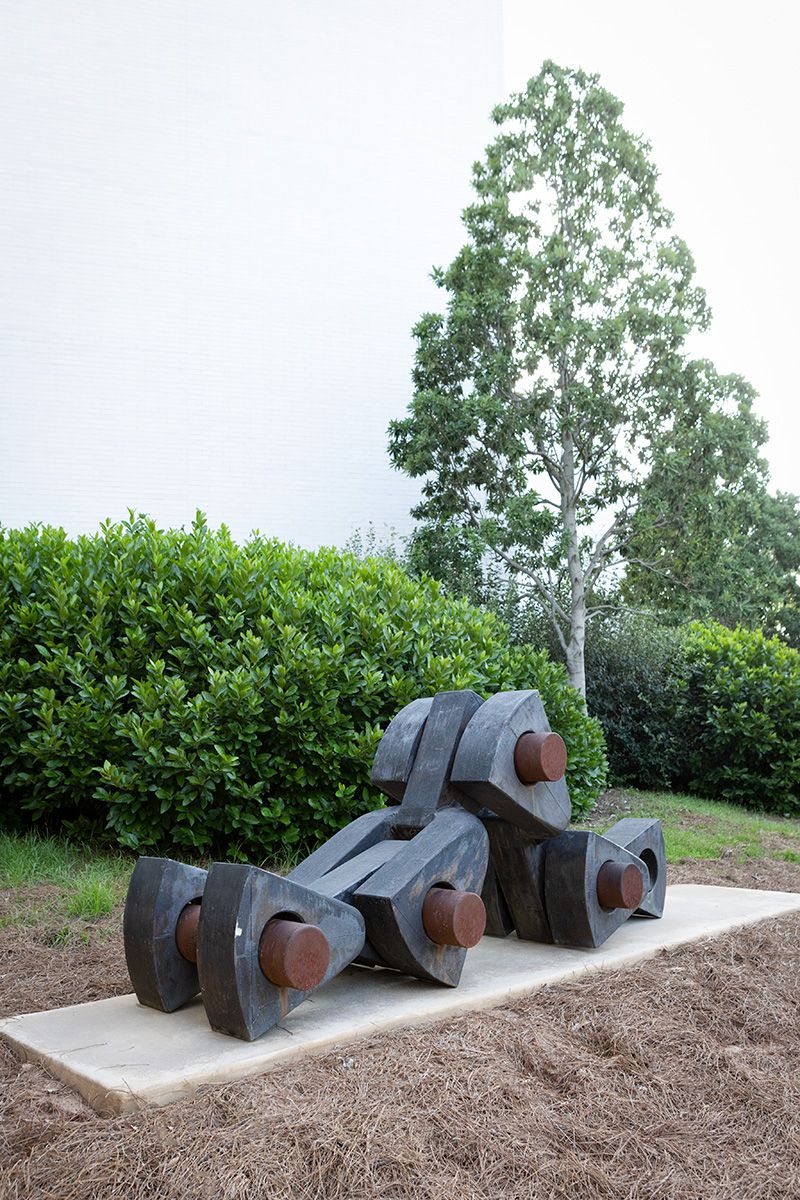
In Articulation, Baskin constructs a system made of connected elements that resemble mechanical parts, joined by steel rods that act as pivot points. These connections allow the structure to shift, tilt, and respond, creating a sense of implied movement. Each section relies on the next, forming a chain of relationships rather than a single fixed form.
Baskin’s work pulls from the designs of mechanical components: gears that interlock, chains that extend and move, and springs that absorb pressure through compression. He isolates these forms, studying how they function, and then reimagines them as sculpture. What he creates is not a working machine, but an artwork shaped by the logic of one.
Drawing on the aesthetics of his childhood home, Detroit, a city long defined by industrial production and its aftermath, Baskin’s artifacts appear worn and weathered, like mass-produced objects shaped by time and use.
At first glance, Articulation may seem to be made of metal. But the linked forms are ceramic, shaped by hand and finished with glazes that mimic industrial materials, suggesting weight, corrosion, and age.
Baskin uses this contrast to explore tension. Just as the appearance of strength in his work is undercut by the fragility of the material, systems that appear stable can ultimately fail, as each element depends on the others, balancing force and resistance.
The title Articulation refers both to mechanical systems and to human relationships, where connection requires flexibility and support, but is always at risk of breaking down. As Baskin explains, these works are not meant to perform the functions they resemble, but instead speak to “the fragility of life, human connection, and how we relate to one another.”