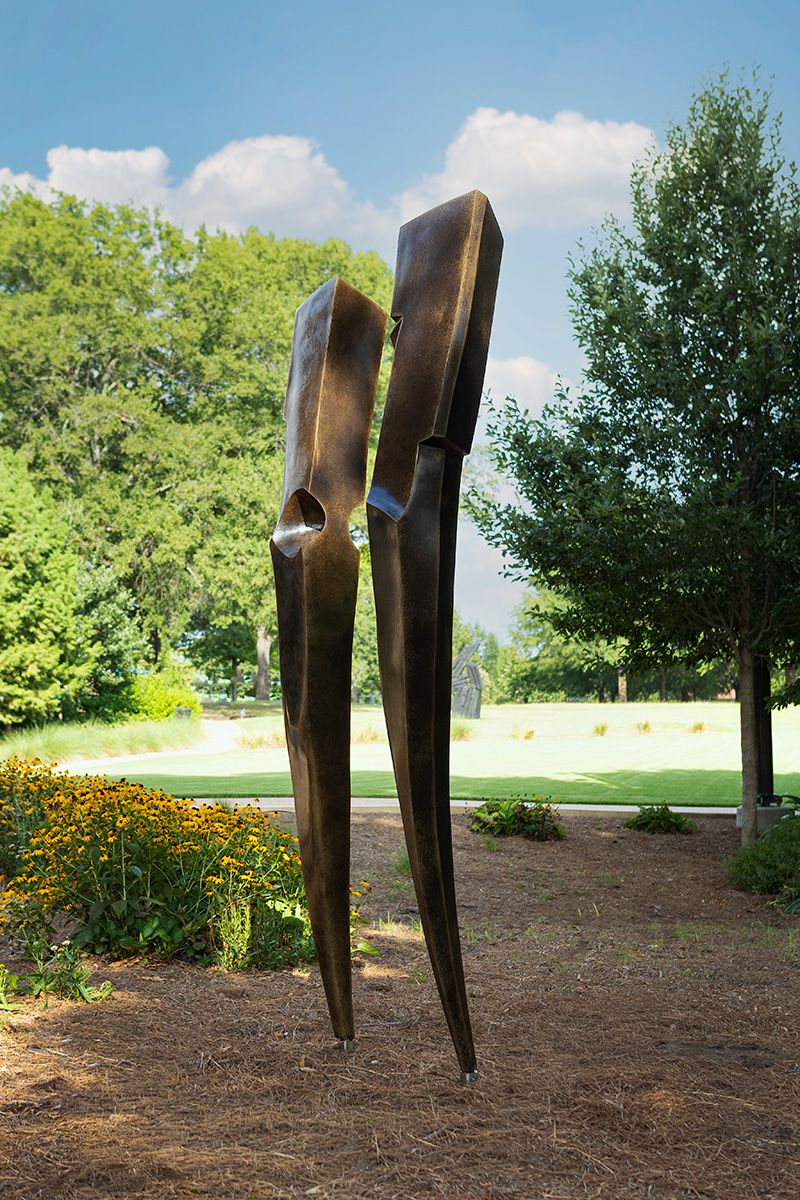
The term "first watch" refers to the first shift of watchkeeping as the night begins. It is a period of uncertainty and
vulnerability that tests endurance and resolve. In Stoney Lamar’s First Watch, two figure-like forms lean forward, as if looking outward, standing at attention and on guard.
Though First Watch is cast in bronze, Lamar has worked almost exclusively with wood. For Lamar, wood is a living material—one that responds to the seasons and is shaped by its environment.
Over decades, he has developed his approach through a process of call and response, where each cut informs the next. This intuitive way of working responds to the material, allowing form and meaning to emerge together.
Lamar first began his path as a woodworker studying furniture making, but his direction shifted after borrowing a friend’s lathe and exploring woodturning. The lathe spins wood and allows the artist to carve into it as it rotates, offering Lamar a different way of working and thinking. Rather than using a single axis to create traditional vessels, he began working with multiple axes to create asymmetrical forms that feel dynamic and even unstable. Through this experimentation, he produced work that challenged what could be achieved in wood.
As his work grew, he expanded his process to include tools such as chainsaws and grinders, allowing him to work at a larger scale. He also introduced materials like steel and paint, creating contrasts between materials, surfaces, and structure.
As Lamar describes, individual marks, voids, and forms function like musical notes, coming together to create harmony and tension. On their own, these elements may seem simple or incomplete, but together they create resonance, where meaning comes from how they exist together.
As his work evolved beyond technique, Lamar drew inspiration from artists such as Barbara Hepworth and Constantin Brâncuși. Hepworth’s impact appears in the use of abstracted, figure-like forms and their relationships, as well as the importance of negative space. The influence of Brâncuși’s Bird in Space can be seen in the emphasis on vertical movement, balance, and presence.
At the time of First Watch, Lamar had recently been diagnosed with Parkinson’s, and in response, he turned to his work as a way of pushing back against the progression of the disease, incorporating contrasting elements that reflect the friction between his mind and body.
First Watch holds this tension. The two forms stand together, not as identical parts, but as a relationship—one that suggests both strength and vulnerability, where the line between them is closer than we imagine.